Sunday, July 3, 2016

Trials and Tribulations

N had returned from abroad to the Brexit situation. While he had tried not to react emotionally, there were times when he felt upset, frustrated, amazed and shocked as to what had taken place in this country, and the racist attitudes he had seen existing. There were also personal experiences, with people talking very loudly. We were always coming into contact with other people and to try to stay present and not react to those things was important - he thought that was where a large part of the Work exists. At the collective level the Brexit vote had taught him not to expect the best of people in this country. He had always thought Britain was a very decent country which he thought it fundamentally was, but he had not been impressed with how we had ended up.

EXERCISE

 Intentional suffering - once a day to compel yourselves to be able to endure the "displeasing-manifestations-of-others-towards-yourselves".


D had boarded a bus to get to the Meeting in good time, but it was diverted as the Hampstead Summer Festival had closed one of the village roads. He had to get off the bus a long walk away, and tried not to react. At first he was fuming but started to calm down. The sun was shining and the little back streets were nice. He found it extremely frustrating. Also, the other day he had been on a bus and two women got on and sat right behind him, although the bus was quite empty. One put her feet up on the back of the seat in front, and the other sat across the aisle, and they were talking so loud, shouting across, and he was trying not to react, although he really wanted to say something. When they got off the bus he smiled to himself, as he thought he had achieved something. So twice he had been in a situation where it was very hard not to react.

RM had been continuing with his meditation techniques and was getting more and more sense of presence all the time. It was no longer just moments. It all started that moment when he woke up, sat on the side of the bed, and did that one-minute meditation. He noticed that as he was more present, there seemed more synergy, harmony with nature. If he was late for the train, the train would be late for him.

T didn't manage to plan intentional suffering but had experienced suffering and had a few moments in the suffering when she became aware that this could be the exercise and to consciously remain in it rather than try and end the situation. One example happened when she had lost her Oyster card, and received a phone message from TFL the day after but the voice was indistinct and then had cut off. She deduced the card had been found, and phoned the number back, only to hear an announcement that it was a TFL number at which no message could be left. There ensued several lengthy phone calls to the main number waiting to be connected during which she began to realise that she was suffering. This change in thinking from suffering to intentional suffering gave her energy a surge. She continued over several days, without giving up, to no material avail, except it had served as intentional suffering for her.

L had discovered that there was no need to go in search of opportunities for intentional suffering. He had bought a kettle some time ago online which was faulty. He had had emails with the firm he had bought it from. They stalled but eventually sent a replacement, but it wasn't left where it should have been and got taken away with recycling. So there was endless opportunity to stay in touch with them and they would keep stalling forever. There was also a problem with broadband at home, and BT was likewise stalling about fixing it, so he could keep phone calls going on with them. They were very annoying phone calls, because he was passed from one person to another, and each time he had to identify who he was, and go through the whole story. So he could keep that going on forever, until he switched to Virgin, which was going to happen sometime soon. So there was endless opportunity for intentional suffering, and it was good to take it with good humour, but of course the natural response was to be very cross.

On a different matter, the referendum reminded him of the discussion last time about gravity, the difficulty of going into orbit and getting away from the pressure against independent thought,  and one way of looking at the referendum was different thinking from a wider authority, and removing institutions from a wider legal system, and it was very hard, there was a lot of resistance, and even after the result, a lot of pressure not to act on it.

Following the contributions, the Meeting moved to responses.

D's trials with the buses recalled to GC's mind an incident years ago when he had the opportunity to negotiate on the price of a house with an elderly man who was very unwell in hospital, with amputated legs. The asking price was higher then GC had been advised it was worth. He decided, under the circumstances, to step back. On reflection, it seemed to him that in certain situations you have to go forward, and not step back and allow life to do what it will with you, because there are certain times when you want to do some thing, or people are annoying you, and you can't just take a back seat. If you opt out and don't have to get involved in these sort of things, sure, live that life, but once you are involved, sometimes you have to step over the line to let be done what you want, because unfortunately if you don't somebody else will. These memories were reinforced by D's account - if someone is annoying you, you either move away from the situation or say something. T said that D had become the puppeteer, he had walked up the string into the puppeteer - he had been watching it rather than being involved in it which was partly an exercise, as most of the time we are tussling with the character in the play.

RM was not sure this was a proper assessment of the right thing to do. He said his understanding was that if you were going to be in the play, play the part. If you were going to be angry, be angry. The main point is to be there while you're doing it, see your body being angry. You live the act of the body doing what it wants to do, but observe what happens. As the body sees the observer, it modifies itself and becomes more subtle in its actions. He thought that to stop and not get involved was missing the point. D thought this was a matter of choice, and you had the power to make that choice. He thought that to react angrily, if you took it to its logical conclusion, was very dangerous, though he understood what RM meant in a higher sense. N said that sometimes we are reacting to absurd situations which we can't affect at all, like the weather. Sometimes there is an impersonality about these situations. Perhaps that was the right attitude to take to Brexit, to accept the fact it had happened. Other situations, such as those D had mentioned, can be changed - you could complain about people talking noisily, but maybe they would react quite aggressively.

Following the responses, the Meeting continued reading from Beelzebub's Tales, Chapter 21.

... endurance towards others' manifestations displeasing to oneself could alone crystallize in their common presences that 'Partkdolg-duty' which in general is necessary for all three-centered beings.


With acknowledgments to Harold Good
Watch on YouTube


T thought  that this was what D had been doing in the episode with the noisy passengers on the bus. RM said that, though D had not been directly involved, his feelings had been involved so he had been suffering. D cited Body Integrity Identity Disorder, in which a person might insist on having an amputation. Doctors tell them it is not rational, but in certain circumstances have performed amputation of a healthy limb for their well-being, and it had produced relief in patients. D did not know why that had come to mind. T said that earlier GC had mentioned a man whose legs had been amputated.

And so, for the purpose of this famous 'suffering' of theirs, many of the three-centered beings of that planet of yours, either singly or in groups, that is to say, with others who thought as they did, began from then on to go away from amongst beings similar to themselves.

They even organized special colonies for this purpose, where, although existing together, they nevertheless arranged everything so as to produce this 'endurance' of theirs in solitude.

It was just then that their famous what are called 'monasteries' came into existence, which exist down to the present time and in which, as it were, certain of your contemporary favorites as they say, 'save their souls.'

RM said this explained exactly how people misinterpret what Buddha had said. They believe they have to do intentional suffering, find others who will share in such a practice, and then they form a club, or monastery, and they feel very good.

Gene Wilder, as Rabbi Avram Belinsky in The Frisco Kid (1979), undermines monastery tradition.
Watch on YouTube


... when these certain parts of the Great All-embracing, already spiritualized by Divine Reason, return and reblend with the great Prime Source of the All-embracing, they should compose that Whole which in the hopes of our COMMON ENDLESS UNIBEING may actualize the sense and the striving of all that exists in the whole of the Universe.

Further, it seems Saint Buddha also told them:

You, three-centered beings of the planet Earth, having the possibility of acquiring in yourselves both chief fundamental, universal, sacred laws, have the full possibility also of coating yourselves with this most sacred part of the Great All-embracing of everything existing and of perfecting it by the required Divine Reason.


T wondered if it was deliberate that the word unibeing can be read as Un-I-Being, a complete absence of "I". RM saw it as Uni-being, the unified one being we were all a part of. N said that Buddhism was a religion which did not require belief in a god, so it was an interesting juxtaposition that unibeing appears in this passage. T thought it amusing that Gurdjieff prefixes Buddha's name with the word Saint, bringing together two different belief systems.

... But when the second and third generations of the contemporaries of Saint Buddha began wiseacring with His explanations of cosmic truths, they just wiseacred with their peculiar Reason and fixed—for its transmission—a very definite notion to the effect that that same 'Mister Prana' already begins to be in them immediately upon their arising.

Thanks to this misunderstanding, the beings of that period and of all subsequent generations including the contemporary, have imagined and still imagine that without any being-Partkdolg-duty they are already parts of that Most Great Greatness, which Saint Buddha Himself had personally very definitely explained.

L found the reference to partkdolg duty interesting, and the idea that nobody can make progress unless they are doing it. He saw it as paying for his life, with the talents with which he was born. T said that partkdolg duty was something other than sitting down meditating for eight hours a day in a monastery. L said that the passage says that Buddhism was misinterpreted to indicate that everybody was born with the capacity that partkdolg duty is required to attain. GC said that if you want to lose weight, it's very simple - Eat less and move more. What we were aiming for was also very simple - Think less and do what needs to be done. It was as simple as that.

... they were warned by still another Saint-Individual, also a genuine Messenger from Above, namely, the Saint Kirmininasha.

And this Saint and genuine Messenger gave this warning to them in the following words:

Blessed is he that hath a soul; blessed also is he that hath none; but grief and sorrow are to him that hath in himself its conception.'


T said it suggested that some people had souls and some did not and that conception meant something had been conceived in that person, and the grief and sorrow is the growing pains. GC disagreed and said it meant that you create your own reality - it was about the issue of mind. RM said it meant if you had your own conception about it, you were in trouble. L thought it meant we human beings were born without a soul, and then by exercising partkdolg duty the soul can be built.

Following the reading, there was a discussion about what exercise to adopt for the coming month, and a suggestion from GC was adopted: When you are in the company of someone who is, in your judgement, talking a load of rubbish, observe your own thoughts and then annihilate them. Then respond naturally.

Sunday, June 5, 2016

The Great Escape

L's experience as the mind emptied was to see images of other places - buildings and people, as if looking through a window to another world. He had been considering D's comments the previous month about the Aymara tribe, and the notion of seeing the past as if it were in front of us, and associations which flow in to the mind are a bit like that because they are normally from the past, and to be able to think freely we might need to break away from that and think of new ideas.
EXERCISE

 Choose a moment each day to let associations recede into the background to receive impressions, and notice if what comes up is associations or thoughts, and if it takes a long time or is instant.

J thought that the main difficulty of the exercise was to be able to distinguish between association and analytical thought. No matter how long or short the process, the idea came in a flash. The question we were all posing was: where did the ideas come from? There was a presumption that we could not find those ideas within ourselves, so they must come from somewhere else. He referred the attendees to the more recent theories about the kernel of the core of personality.

N noticed that it was very hard to look at things without ideas already being in his mind. He was prejudging things, and tried to look again and see things differently, that were not seen previously. He found we lived in a daydream world where we accepted things as being out there, and when he started questioning that - Is it quite like I think it is? - different perceptions came to him, and he started to look at things in a different kind of way, almost trying to intuit them, to sense the essence of what they were about rather than his preconceptions of what they were about. The exercise for him, was about getting back to the earliest impressions of things noticed as a child, or when he looked at objects or found some mystery in them.

When "R" was trying to write something for a deadline. It was an interesting exercise to focus on an aim and try to put it into good words and communicate. This process involved the brain, but there were no new thoughts, it was all about sorting out the associations and prioritising them and then being able to put everything in order on the computer. Struggling with the computer was a challenge as well, because when she had written books before she had done them in the old fashioned way on typewriters and sheets of paper, but to appreciate herself trying to be receptive and focused on what was necessary to phrase something properly and condense it into few words (because there was a word count limit) was quite a discipline and much more difficult than it had been twenty years ago. The activity - or non-activity - sitting on her chair at her desk at her computer for hours at a time, had made her realise how deeply asleep she was on every topic except the subject of the writing.

D had been looking on the internet about so-called enlightenment and so-called gurus, some of them probably pseudo-gurus, talking about it. What he got from most of them, which he had condensed to the most important, simple thing, was that we were an open vessel, a clear vessel, whereas all the rest - thoughts, feelings, perceptions - was noise which stopped us being in the moment. He was aware how much he would lose concentration whilst listening to people, and then go back to what he was thinking. The Aymara idea that the past is in front of us puts all experience in to the now, so that the past is here, present. The future is unknown, so, to them, it is behind us, out of sight. When people said the same things they were saying ten years before, it was the conditioning mind - the past in front of them.

Pinocchio marionette by Jim Shore
RM was working on a chapter on free will in the book he was writing. He asked himself: is everything I do here now, even to a thought, consequent on something that went before it? So far he had not found anything, even to the smallest degree, that wasn't. The more he considered this and read about it, the more he came to the conclusion that we were like marionettes and did not have free will. The positive side of this was that you could let go of all opinions and go with the flow of nature. It was like riding a bike, you could not decide to ride it a different way, because if you tried it would cause a crash. He found that every time he tried to go against the natural flow it caused him distress.

Sakura (cherry blossom)
Recalling the exercise for the meeting T was aware that during the month she remembered the exercise in the first and second weeks, but after that it was gone from her mind. She remembered vividly a tree moving in the wind, but after three or four seconds without thinking, she realised what was happening and the thoughts started coming. She was shocked by how minute the time was, and it was also frightening, because she experienced for a moment something in the raw that wasn't her.

The Meeting moved on to the responses.

D said that he was beginning to agree with RM, that people did not have free will. "R" asked, bearing in mind that everything might be the result of the influences we had been under and the things that had happened, whether there was any way that we could choose only to be influenced by cleaner influences. D thought we could, but that it would take time. "R" agreed, saying it was because everything is associations. J said that there might be a presumption that we could not have original thoughts, but he saw it more like a mason choosing which blocks to build with. The blocks, like those unoriginal thoughts, are all ready-made but the mason can choose which blocks to use when building, and likewise we could have very original thoughts by using different combinations of the blocks we had, but we could not operate in a pure mathematical vacuum without actual ideas or building blocks in place already. To say that we had no original thoughts or were asleep all the time was a bridge too far. It was the synthesis between the building blocks which was the original thought. L said that in the Gurdjieff Work, there was the idea that you could have free will, but it took a tremendous effort and you could not do it for long. He had been watching an interview from the Recode 2016 conference a couple of days before in which Elon Musk had clarified a common misconception about gravity. When we see images of people on the space station floating, we might assume there was no gravity there, that they had escaped the earth's pull, but in fact the force of gravity there was much the same as on earth, and the weightless effect was produced only by spinning the craft sufficiently fast around the planet to prevent it from falling. L said this was analogous to the enormous effort needed to exercise and maintain free will. "R" said that Beelzebub speaks about the Law of Falling in Beelzebub's Tales and about how the spacecraft that he is on is travelling. N found it an interesting analogy, and said that part of the Work was finding one's own centre of gravity. The daily exercises show how difficult it is to maintain free will, and our struggle with the exercises showed us how asleep we were and as a result the Work showed us very clearly that we do not have free will, and we kept falling back out of and away from a sense of our own centre of gravity. J was unsure about the idea that effort is needed in order to produce a new thought, because inspiration can come without effort. RM said that the great freedom was to be free of your own ambitions and intentions, your own attitudes and views - the minute you were free of that, you let go to nature to follow its own course. T thought that this sounded like going to sleep, because we were responsible for our own human nature.


Following up T's memory of vividly seeing the tree for a few seconds, D asked if the fear she had experienced was partly a consequence of how busy her life was. Someone who was not busy, who spent a lot of time in meditation, might find it easier to be in the awake state, because they had already built that block. "R" said it was also possible for a busy person to have the same experience, by bringing the three centres together. D thought that the experience might last longer for the less busy person.

The reading then continued from Beelzebub's Tales, Chapter 21.

...a suitable Sacred Individual was immediately sent here, so that ... he might better explain and show you the way of eradicating from your presences the already crystallized consequences of the properties of the organ Kundabuffer as well as your inherited predispositions to new crystallizations.

With acknowledgments to Harold Good

During the period when the said Sacred Individual, coated with a presence like your own ... directly guided the ordinary process of the being-existence of your ancestors, many of them did indeed completely free themselves from the consequences of the properties of the organ Kundabuffer ...

But ... the duration of your existence had ... already become abnormally short, and therefore the process of sacred Rascooarno had also very soon to occur to this Sacred Individual, ... then after his death, the former conditions were gradually re-established there owing on the one hand to the established abnormal conditions of ordinary being-existence and, on the other hand, to that maleficent particularity in your psyche, called Wiseacring.

For T the talk of abnormally short periods was like the little periods of enlightenment she had experienced. D queried what Wiseacring was. RM read out the definition from the Oxford English Dictionary: A person with an affectation of wisdom or knowledge, regarded with scorn or irritation by others - from Middle Dutch wijsseggher 'soothsayer', probably from the Germanic base of "wit". L said that when reviewing the Meeting to work out what goes into the blog, there were some parts which were very focused on what was being read, but there were a lot of sections where the talk was of things completely unrelated and would go off track, and then the word wiseacring would then come to his mind. Everyone present provided their own understanding of the word and there was a long discussion about what it meant. J added that the use of the adjective maleficent suggested it was a particularly bad trait. He thought Gurdjieff had put the idea very well a little earlier, when he spoke of our "inherited predispositions to new crystallizations". which also related to the earlier discussion about originality and synthesis,  T thought the use of the word coated was interesting, as if it described the superficial shell you can see of somebody else, like icing. "R" said it was personality, not essence. "N" compared it with crystallisation. An object might get a shell or a coating which did not belong to the original thing itself and therefore changes it. "R" said that after crystallisation a material was no longer fluid and movable, and was difficult to dissolve. N thought it might be analogous to the start of mechanical, less fluid thinking. These thoughts reminded L of the historical psychological symbolism applied to chemistry by alchemists.

... After having said all this, Saint Buddha ... explained to them how the process of their existence must be conducted and the order in which their positive part should consciously guide the manifestations of their unconscious parts ...

RM said we had to separate the ideas of knowing and thinking. Some things were beyond our thinking but not beyond our knowing, for example riding a bike. "R" said that the body had to learn the skill first.

...One of the best means of rendering ineffective the predisposition present in your nature of the crystallization of the consequences of the properties of the organ Kundabuffer is “intentional-suffering”; and the greatest intentionalsuffering can be obtained in your presences if you compel yourselves to be able to endure the “displeasing-manifestations-of-others-towards-yourselves.”’

This explanation of Saint Buddha together with other definite indications of His was spread by His nearest initiates among the ordinary beings there; and after the process of the sacred Rascooarno had occurred to Him, it also began to pass from generation to generation.

Following the reading, "R" observed that intentional suffering had just been mentioned, and this was adopted as the exercise for the coming month: once a day to compel yourself once a day to be able to endure the "displeasing-manifestations-of-others-towards-yourselves".

Sunday, May 1, 2016

Looking backward


EXERCISE

 To notice each day a thought which seems to arise of its own accord and try to see where it comes from.

D had been attending a class which described the Aymara tribe's concept of time - that the past was in front of us, while the future was behind us because it had yet to come. People projected their minds and their history on to the world, and the only way to stop that happening was to be in the present. He found this a very interesting perspective.


N had found that his thoughts came sometimes from body states (he had experienced some bronchitis during the past month from which some thoughts had emanated), or emotional states including from dreams. For example, on one occasion he awoke with feelings of anger which were hard to quell and which he assumed came from an experience while dreaming.

T had noticed a theme running through the thoughts that entered her head, which was a concern about how she might be viewed by others. She had traced this tendency back to childhood. For example, she had been prescribed exercises to ease a rotator cuff injury, and wanted to do them while walking or waiting at a bus stop, but had felt uneasy about how she would appear.

L said he had thoughts coming all the time and was not sure where they came from, but the exercise made him think of the relationship between our experience dreaming and our experience "awake". This reminded him of the animation Waking Life. These thoughts were like dreams - it was very hard to find out where they came from. They usually did have a source; it might be to do with puns or word-play, or similarities of colour or shape, or context of events in the past, like smells. It seemed to be an automatic process. For him as a composer it was especially interesting, as music was entering his mind all the time,  He had woken with some this morning, and had got up and recorded it. So he was obviously interested in where this music came from. Did it come from nowhere? Or was it actively brought by some agency? That was actually the theory he was working with. He followed the Ancient Greek belief in the Muse, and the Muse bringing inspiration to those who were going to transcribe it. But also, just as in dreams, the conscious mind was incredibly creative in creating scenarios and he thought that could also happen in waking life.

G said that a problem had come up abroad half way through the previous week. He started thinking about it, and realised that thinking about it would not do anything, but just create doubt within him, throwing each scenario backwards and forwards. He thought the process would stop if he didn't open the door for it. But over the next day and a half it crept in again like a naughty child. He thought that he had to think about it, as if he had a moral responsibility to do so, but thinking was not going to help, and if it was going to help it would be resolved in about twenty seconds, because you would resolve to do this, or that, or leave it. But the mind kept throwing it at him, just like a naughty child, and you had to put some form of discipline before it.

"R" had been writing a book, and had a deadline coming up. The book had to be full of information. It was not a novel. It had focused her attention on what is remembered and what isn't. She wouldn't call that thinking, she would call it associations. She has noticed the way that the "database" in the mind would just slow down. It seemed to be working at half speed a lot of the time, so trying to pinpoint a particular bit of information, she had to wait, do something else, and then it would pop up. Rather as GC was saying, it was not intentional access to what she wished to access. The other side of the same thing is how is it that anything is remembered?  Real thinking, it seemed to her, was to be solving problems and inventing solutions to the requirements of life that crop up. It was distressing and puzzling to consider that one was no longer in control, and never was.

Following the contributions, time was given to responding.

Tony Buzan
Tony Buzan
D thought that "R" must have some sense of control. Without that we wouldn't achieve anything. "R" replied that we don't achieve very much. Although she had written books before, the process, though it might appear to be the result of intentional thought, was primarily the consequence of assembling associations which apparently came at random to the mind. N added he used to teach courses in mind mapping and creative thinking, including the techniques of Tony Buzan, He advocated doing "mind-dumps", maps of associations to help in writing about a subject. N thought this was a good way of making use of the associations, having compiled them into a map, it was then possible to decide on a direction. "R" said that she did that, but the question was who is doing the deciding. N said that we were trying to become the master of that process. "R" said that there were moments of mastery, but to permanently put that hat on was a different matter. D asked "R" how did people meet deadlines. "R" said that some people drive themselves very hard to the detriment of their health. D said that some people consistently meet deadlines. L said that the Work looks into the possibility and development of a single "I", and where this is absent, following the instructions of an employer - or the requirements of a customer - works similarly. D said that what we were discussing and ultimately working to achieve was free will. GC thought the problem was the negative self-talk which can arise from thoughts, and that it was very important to recognise that process when it begins. This reminded T of a slide - as the descent picks up speed it gets harder to stop. GC agreed except for the connotation of pleasure. L said that if he was right about music coming from outside, he could infer that thoughts might also come from outside, as poetry might come to the mind of a poet.

The reading then continued from Beelzebub's Tales, Chapter 21.

With acknowledgments to Harold Good
By certain all-enlightened and all-justly guiding most sacred final results of the actualization of everything existing in the Universe, my essence has been sent to you to serve as a helping factor in the striving of each of you to free yourselves ...


Pineapple flower
D raised the issue of the wording used, that Buddha's essence had been sent. He said that Buddha had not been born with an essence. L quoted Charles Rennie Mackintosh, the architect and painter - "Art is the Flower - Life is the Green Leaf". He saw art as the flowering of the human being, and maybe that was essence asserting itself, but maybe it was also about a growth of essence, a development. It was natural for plants to flower though sometimes they did not. We had all probably enjoyed pineapples, but who knew what a pineapple flower looked like? D said that the caterpillar was not the butterfly. The notion of metamorphosis was helpful to him. GC asked how did we know that essence really existed? He said that each person at the Meeting was using different words and metaphors to approach this issue. He personally kept returning to mind and thinking - thoughts came from nowhere and the mind - the physical brain in action - seemed to be attracted by negativity. He said that others spoke instead in terms of art or associations.

Art is the Flower - Life is the Green Leaf. Let every artist strive to make his flower a beautiful living thing, something that will convince the world that there may be, there are, things more precious more beautiful - more lasting than life itself... you must offer real, living - beautifully coloured flowers - flowers that grow from, but above, the green leaf – flowers that are not dead – are not dying – not artificial – real flowers springing from your own soul – not even cut flowers - You must offer the flowers of the art that is in you – the symbols of all that is noble – and beautiful – and inspiring - flowers that will often change a colourless leaf - into an established and thoughtful thing.

Charles Rennie Mackintosh

... namely, there was implanted into their presences a certain organ with special properties, owing to which everything external perceived by their whole presences and transformed for their own coating was afterwards manifested not in accordance with reality.

A little later, ... our MOST ALL-GRACIOUS COMMON FATHER did not fail to give the command immediately to annul certain artificial measures, among which was the removal from the common presences of your ancestors of the now already superfluous organ Kundabuffer with all its special artificial properties ...


GC asked what kundabuffer was. "R" gave the metaphor of a flock of sheep, who are not aware of their purpose being to be slaughtered and fed to other beings. Some people were quite happy with their views, but if you had a question you already had the energy to develop it.

Following the reading, an exercise suggested by "R" was adopted for the coming month: to choose a moment each day to let associations recede into the background to receive impressions, and notice whether what comes up is associations or thoughts, and whether it takes a long time or whether it is instant.

Sunday, April 3, 2016

Just a Thought


EXERCISE

To notice each day if and when you experience something or do something or behave in a way that is authentic and to observe if there is any association with isolation or fear of isolation.

T's understanding of authentic was to be the author of what she was doing, to be the motivator of her action. She observed during the month that this was a rare occurrence. Most of the time she was doing things because that was the task set her by her employer or because she was reacting to what she thought other people required or needed from her. She observed being the author of her actions and experience only a few times and this happened during the time she regularly scheduled for her own painting and nobody else was requiring her to do it. This was the time and place where the potential for authentic behaviour, being the author of her own action, could happen. This was also the time when she observed the most resistance to making the task happen, resistance kicked in with a vengeance. She generally experienced insidious self-generated resistance to organising herself to actually stand at the easel and paint. She associated this difficulty with the anxieties and fears that arose from turning her back on other people and being on her own with her task which was necessarily isolating.

The only way to be an author was to be alone with the task. Even with the circumstances in place, the studio, the materials, the time, the conviction, there was still the battle with distractions from the task, distractions that arose from nowhere and suddenly became all important to give attention and time to, I'll just do this before getting to the studio, and when in the studio, I'll just do this before standing at the easel. But then after the resistances to painting were overcome and the painting commenced, that's when she experienced a sense of authorship of having arrived somewhere where she was challenged at a deeper level than usual to be true to her own experience and level of understanding and to construct something from that position. This place was another form of battleground but on a different level. The challenge was to being true to what she perceived at the present time and not to respond or react on assumption of what she perceived of the same subject before. The challenge was to construct something from the coal face of the current encounter. This work could only be achieved alone and the challenge of the difficulty of doing it made her sweat. There was a personal battle going on or a relationship or a responding to the experience of being a human being in the phenomenon of the world.

The film directed by Jake Auerbach, "The Last Art Film" interviewed Michael Craig-Martin, Professor of Fine Art at Goldsmiths, who passionately described his message to art students. "Once you don't have an art school behind you, nobody cares whether you get up in the morning, nobody cares whether you do a painting, even your best friend, even your parents, can only care a limited amount. Nobody really is that interested in this until you've done it." He emphasised that the Art student should be under no illusion that what they do matters to the world of others. The artist before they have made anything is never acknowledged and it's only after the event of creating something, after they've done the work, and not before, that there is any possibility of acknowledgement. An artist has to be self-motivated and has to face aloneness with the task. T remembered at art college, one of the students, who was doing a lot of work painting from life, saying, "The artist's life is a lonely Om". She didn't like it much at the time, and she didn't like it now.


L said that for him the exercise had been very similar to the previous one, which had been to notice ourselves lying. And when we were lying, we were not being authentic. Very often, also, it was to do with isolation. The fear of isolation made us pretend to be what we were not, or to fit in to whatever social expectations happen to be. We could see lies in advertised commodities, for example decaffeinated coffee, which he was not sure made sense, although he sometimes had it, but obviously coffee should be caffeinated. He would see people walking, sometimes very swiftly, or with a peculiar gait, and it seemed to him that this might reflect ego, something in the mind, it was not a natural state. He had noticed that he sometimes had his tongue between his teeth when he was not thinking straight, or when his mind was getting diverted. In art, he had been trying to compose music more authentically, and he had been doing this by singing in to a multi-track recorder from inspiration, and then trying to represent that as authentically as possible by copying, transcribing it. That was like painting from life, bringing to this world, as authentically as possible, mysterious inspiration, which came from we knew not where.

N had found this a very difficult exercise. As L had said, it related to the previous one to a certain extent about lying. Because we spend so much of our time lying, and it becomes a habitual thing, it was hard to actually experience authenticity. He was not sure though that all authentic experiences were necessarily ones in which you felt a sense of isolation. He thought sometimes you could feel a sense of liberation, a joy in being authentic. He thought part of what this work was about was actually to step outside all of that conditioning. Whatever religion you were, whatever social class you were born into, to be able to see the world differently and detached from that, this for him was part of what this work was all about, and to realise it was purely an accident of birth where or how you had ended up in this world. His experiences during the month had been ones of trying to step outside his social conditioning, and see the world differently from that perspective. Sometimes there might been feelings of isolation, or fear which came along with that, but other times there had been a lot of liberation.

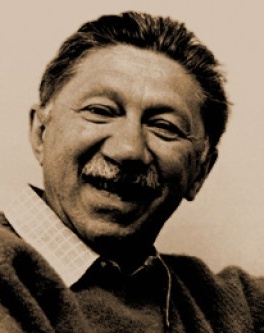
Abraham Maslow 1908-1970
T started the responses to the contributions, saying that she had been touched by N's comments that it was sometimes a liberation. T experienced this for just one second, while sitting on a bench in the park in the sun. She wasn't doing anything, and it took her by surprise. N asked T if she could describe that state a little more, and T said she could not, it was an impossible thing to chase, no matter how many meditations you did a day. She wondered if N had any examples of his description of either of those states. He said that there was a feeling of great meaningfulness and significance. Quite often there had been a lot of work prior to one of those experiences, a state impossible to chase. It comes as a gift, you can't expect it, it just descends. Maslow called these peak experiences.

JE said that if you were thinking or moving in a different direction from everybody else, you could feel very isolated. L agreed, saying that if that feeling became very strong, then it might impel to go back into the herd. In animals which moved in herds, there would be one or two which did not, but most joined the herd, and there were reasons for that, it was easier to get food if you were part of the hunting pack. That happened in human life, it was easier to get food if you joined one of the standard professions or jobs. N spoke of a book published in the 1950's called The Lonely Crowd, by the sociologist David Riesman, who discussed why people felt very lonely and would give up their freedom to join authoritarian groups or cults. T thought that we all fantasised that there was a tribe to which we were supposed to conform, but maybe it was a survival instinct from millennia ago to be together so that at least one person survived the trials and tribulations of being in the stone age.

J quoted the ancient Greek saying Know Thyself. While isolation as a word had pejorative undertones, but if it was a case of separateness because you wanted a detached, more correct perspective, that was something different. If we had considered our position in relation to the customs that surround us, then the departure from the norm should not be something that either frightens us or gives us a feeling of isolation, but was rather a comment on our conditioning and our personality rather than the actual problem. T said that the alternative word was solitude, which was less pejorative. It had a ring about it which suggested you ought to enjoy it. C said that the three letter root sol appeared in each word, associated with solo. To her isolation was active, something chosen, whereas solitude was something felt.

J asked how sophisticated did Gurdjieff say you had to be before doing this exercise. How could it help a terrorist who has only become one because he was bored. L suggested imagining that when people came through the door of the Meeting, they left their personality behind. Religious belief would likely drift away, and there would be no question of any belief in violence in pursuit of a religious conviction. Some essential qualities might be left. G asked L if he could define essence. L was not sure how much he could demystify the mysterious. If you took off all the wrapping, what was left inside? Perhaps it could be built on.

P said, on the subject of what is the essential person, at lot had been written over many millennia, and he was sure that Gurdjieff had incorporated some of this into his writings. In the tradition he came from, which was very ancient, there was a difference between essence and the secondary personality. Essence was seen as something changeless, which required uncovering. Nothing was required to be added to it. In Sanskrit, essence was called jiva or pramana, it was the soul. Personality consisted of acquired characteristics. Our anxieties, our nervousness, our neurosis, our joys, our pleasures - a sense of identity - and they would change from body to body. "R" said that P had been the first person to mention "body", and in fact Gurdjieff gave the body great importance in the sense of physical presence and experience related to the body. The Know Thyself in terms of ideas was only because we had a body which could do the thinking, and we did not respect enough what the body was for. Gurdjieff offered an idea of how to experience things which was to do with being present, and in those moments it was possible to have that solitary understanding.

The Meeting then continued with the reading from Beelzebub's Tales, Chapter 21, page 231.

With acknowledgments to Harold Good
For the first days, the aforementioned terrestrial professionals of that time who had chanced to arrive there did nothing but gratify to the full their inclinations, which had already become inherent to their presences in respect of the destruction of these one-brained beings of their planet...

... when that second catastrophe occurred to your planet, then many of the beings who chanced to be saved from the continent Atlantis, chiefly those who already had relatives and kinsmen in that Pearl-land, also gradually collected there.

P asked if this was supposed to be true. N replied that it was fiction, but there were a lot of symbolic references. L said that the present section described how humans killed oysters for their pearls. It followed earlier sections in which reforms were made to reduce the killing of animals for sacrifice and later for food. L said that Gurdjieff had written with great compassion about the plight of animals. GC said it was wrong to deduce from this that Gurdjieff had advocated vegetarianism, and in fact the man had been a big meat eater. L asked how he could be sure the accounts he had read were true. "R" said she had personally met people who had enjoyed meat meals cooked by Gurdjieff. L said the passages in the book were attributed to a character, Beelzebub, and were thus not necessarily Gurdjieff's own views. However it was easier to be a vegetarian now in North London than in the Caucasus a hundred years ago. T wondered if the talk of the planetary body was a metaphor for the human body and that the something "catastrophic" was something that had happened to the individual human being, or humanity. We were born into the world and then something cataclysmic happens which affects us for the rest of our lives.

...But it turned out that amongst the beings of this third group of the continent Ashhark, there were at that time several peculiar 'Havatvernonis' or 'Religions' all based on different, quite independent what are called 'religiousteachings,' having nothing in common with each other.

...Before continuing to tell you about the three-brained beings breeding just on that part of the surface of the planet Earth, it is, I think, necessary to remark, even if briefly, that there existed and still exist, ever since the time when the practice of having peculiar being-Havatvernonis or Religions began to arise and exist among your favorites, two basic kinds of religious-teachings.

P thought this was outdated, as he thought that in 2016 it was known that they were all based on the same fundamental principles, and were contradictory only superficially. JE disagreed, thinking that Gurdjieff was deliberately referring to the external practices of different religions. J thought that Gurdjieff was very much anchored in his time with his preconceptions and had not escaped into his essence. He thought a lot of it was not 2016 thinking. P said that the Internet enables people, with just a click, to learn what Gurdjieff had to travel for two months on a camel to find out about.

...It was just then that the aforementioned Sacred Individual was sent to them who, having been coated with the planetary body of a terrestrial being, was called, as I have said, Saint Buddha.

...During my detailed studies of the mentioned religious teaching I also clarified that after this Sacred Individual had become finally coated with the presence of a threebrained being there and had seriously pondered how to fulfill the task that had been laid upon him from Above, he decided to attain this by means of the enlightenment of their Reason.

GC asked what the final sentence meant. "R" said it meant that rather than setting an example, he would explain things. P thought it was a reference to Buddha.

Following the reading, an exercise suggested by GC was adopted for the coming month, to notice each day a thought which seems to arise of its own accord and try to see where it comes from.

Sunday, March 6, 2016

The Poor Law


EXERCISE

To notice oneself lying, and make a note each time.

This exercise had prompted L to recall a joke M used to tell.

Question: Why do tall people get up late?
Answer: Because they lie longer in bed.

L had noticed that he was lying nearly all the time. Exceptions were while working on art, because that had an essential quality, and likewise while working on the blog. Whenever he planned to do something and did not, that was lying to himself. The to-do list system which had many to-do's listed was a stark reminder of numerous intentions and fewer follow- throughs. He was still doing the three things a day exercise, so that was a small area where that lying did not happen. When he made an appointment to be somewhere and was late, that was also a form of lying.

D said he wished M was there because he wanted to ask him about his experience of aging and age. He had been living in illusion most of his life and still was most of the time. His 75th birthday was coming up later in the month. He was thinking of the past a lot, of times in childhood. He had been in a lot of institutions, and rebelled. He was not in the future. He was either in the present or the past. He said this was typical of people as they got older.

N joked that his work as a lawyer meant that you could say he was a professional liar. He did what he could to reduce conflict. His clients had decided to be litigious in the belief that they had been wronged and had a case to be fought. He defended his clients in court to help them win their litigious battle. The judge heard both sides and then made a decision. When N considered there had been a miscarriage of justice he could take the case to a judicial appeal for the case to be heard again. N had one client who was undoubtedly an honest, hard working man who had been made bankrupt by several others who had ganged up against him to achieve this. He had taken this case to judicial appeal to try to reverse the judgement in favour of his client.

T had thought that she wouldn't have anything to talk about as she considered herself an honest person. However she experienced a shock at three weeks into the month when she experienced a case of herself lying at work. It had been agreed that she regularly worked late and she was careful to keep to the correct hours. There was a system of signing out because of fire regulations and one evening she hadn't felt well and left early but signed out at the usual time, so that the boss would not have to know. She realised that this was a lie. What she observed was that she immediately thought of having to say this at the next meeting and that she felt utterly ashamed of what she'd done and the shame triggered her to consider not describing this event in the meeting after all which she then realised was a second lie compounding further the first lie, and her identity as an honest person began to develop cracks. This realisation about herself was uncomfortable and shocking and distasteful. She experienced an emotional struggle going on inside, on the one hand wanting to deny this unsavoury aspect of herself and cover up, and on the other hand wanting to be honest about her dishonesty and accept the uncomfortable truth that she was not so honest after all. She was aware that it also brought back feelings from childhood of having to be honest and if you weren't honest then you were bad. If you were honest you were good. She wanted to be seen to be good and this triggered lying to keep up this illusion. For her the exercise had been an effective self observation tool.

"R" had been spending time with one of her grandchildren who was on the autistic spectrum. He was now 11, and was reading a lot, an enormous amount of which stayed in his mind. He would repeat back everything he read at great speed. This highlighted for her how much we acquired by reading, and then repeated this acquired information as our own experience of the subject and fact, whereas it was not fact and only acquired knowledge, not knowledge through experience. So she realised how much of what she said was, by virtue of this fact, a lie. This was difficult.

RM had not done the exercise because he continued with the one that works for him, to wake him up. He uses a one minute timer on waking and then 15 minutes with 4 minute chimes to wake him up to being present. He developed this further during the day using the timer chime in various daily situations, such as driving in the car, to wake him up to be aware of the present that he was in. This was transforming his experience of his day and it was extraordinary.

JE said her work consisted in helping people, but she felt she was helping others in areas that she was unable to help herself in. In this sense her work was a lie. It would be better if she didn't help others and they had to do it for themselves, and then they would learn something real.

http://cliparts.co/listen-to-music-clipartGC said that when he listened to the radio in his car, he normally did not listen to the news, because he considered it manipulation of the facts. He habitually turned it off and then turned it on again after several minutes in order to purposefully miss the news and then to continue listening to music. But he was aware that one time he didn't turn it off in time, and something in the news caught his attention. He continued to listen before realising that the newsreader had gone onto two or three other subjects and becoming aware that what he was listening to was not what he wanted to listen to and was no longer something of interest to him. He commented on how quick it could be to stop being awake.

After the contributions, L responded to D's comments about his experience of being more focused on the past as he got older. He recalled that there was a Chinese parable of two tigers which described maudlin perspectives and appropriate action, and T elaborated on it.


This parable reminded L of the old Jewish saying: Life is a narrow bridge and the main thing is not to be afraid.

JE responded to L's comments about the connotation of essence with creating art. She had come across Gurdjieff's concept of objective art which had a visceral power which seemed independent of the artist. She had been invited to a Persian New Year event and had the opportunity to hear some old Persian music which seemed to communicate directly to her. L said that artistic ideas and inspiration were real, but in themselves unfashioned, like diamonds brought up from the mines. Later the artist will work on that gem to provide many different perspectives and structure. Perhaps the power of Gurdjieff's objective art lay in the unearthed gem, without which the finished product would be impossible, but it did require human work to make the art. L saw in this an interpretation of the concept of transforming coarse materials into finer ones., which "R" had quoted Gurdjieff as saying was one of the purposes of humans on the planet.

GC said that when he first visited Israel he had felt nothing, though he was supposed, as a Jew, to have felt something. On the other hand, he had visited the Arab countries and did feel something. But when he first stepped off the plane into India it felt to him as if he had come home! He asked about the nature of that experience. L described Israel as a politicisation of Jewish culture, and it was no longer real feeling that drove it. It had become nationalistic. T commented on how India had centuries of meditation practice as its traditional custom for all, which might have affected the subtle energies of the whole continent, which maybe was what GC was experiencing when he went there.

RM said he had listened to N and T talking when they were giving their contributions, and had noticed that N used the word "you" rather than "I" which gave him the experience of being told what he and others had experienced but not what N had. When he heard T speak she said "I" and this had communicated her experience more directly and felt more authentic.

Frank Auerbach, painter.
Photo by Nicholas Sinclair
GC said that he was a professional gambler. All his life his career had been in gambling, and the experiences of winning or losing were no different. He had earned a living from it, and he had won a lot and lost a lot. But he kept on doing it. This reminded T of visiting the Auerbach exhibition at the Tate Britain. At the end of each day, the painting had been worked on; adding layers, taking layers away, adding layers, trying to achieve, to a hair's breadth accuracy, a visual response to his experience of his surroundings. This approach often left him with a scraped off canvas at the end of the working day, with apparently nothing left to show for all his work, except the chance the next day to try again. Each painting was worked on for years, not months. This process seemed to be one of winning and losing, gaining ground and then losing it, to gain it again, echoing the gambling, winning and losing. The gambler, the painter, immersed in a process that was based on trying one's luck, taking chances, using all one's knowledge of the field to play the field. T described Auerbach's approach to painting as above all an honest approach. Auerbach tried to be as truthful and honest to his experience of the "fact" that was in front of him, the human figure, face, landscape, or mix of all.


The Meeting then continued with the reading from Beelzebub's Tales, Chapter 20.

With acknowledgments to Harold Good
Beelzebub continued to speak as follows:

Sitting in a Chaihana in this small town of Arguenia, I once overheard a conversation among several beings seated not far from me.

They were talking and deciding when and how they should go by caravan to Pearl-land.


Having listened to their conversation, I gathered that they intended to go there for the purpose of exchanging their 'turquoises' for what are called 'pearls.'

I must here, by the way, draw your attention also to the fact that your favorites of former as well as of contemporary epochs liked and still like to wear pearls and also the said turquoise, as well as many other what are called 'precious-trinkets' for the purpose, as they say, of 'adorning' their exteriors. But if you would like to know my opinion, they do so, of course instinctively, in order to offset, so to say, the 'value-of-their-inner-insignificance.'

... As a result of it all, we also were then included in the company of their caravan, and two days later we set off together with them.

... After every kind of difficulty we at last, one rainy morning, on ascending a height, suddenly saw on the horizon the outline of a large water-space bordering the edges of the continent Ashhark, which was then called Pearl-land.

...It cannot be helped, my dear Hassein. Now that I have told you the history of the arising of the second group of the three-brained beings of the continent Ashhark, I must tell you also about the history of the arising of the third group.

"You must indeed tell me, my dear and beloved Grandfather," eagerly exclaimed Hassein; and, this time with great reverence, extending his hands upwards, he sincerely said:

"May my dear and kind Grandfather become worthy to be perfected to the degree of the sacred Anklad'!" Without saying anything to this, Beelzebub merely smiled and continued to relate as follows:

L queried what the term Anklad denoted. "R" said that this was revealed near the end of the book.

Following the reading, there was a discussion on what exercise to adopt for the coming month. As there had been much talk of authenticity and isolation, a suggestion from L was adopted, to notice each day when one behaves, experiences or does something authentic in nature, and to observe if there is any association with isolation or fear of isolation.

Sunday, February 7, 2016

Let Us Bray


EXERCISE

To do something twice every day. The first time might be habitual, and the second time with more awareness, working to be awake.

RM asked what the exercise had been. He intended to stick with things that worked for him. He did a one minute exercise every day and had been doing it for some years.

Domhnall Gleeson demonstrates a variant of the exercise, in the movie "About Time" (2013), directed by Richard Curtis.

N had found it a more complicated exercise to do than trying to remember himself by counting lamposts. He had been trying to diet, and had been using that as a Gurdjieff technique. He had also had quite a lot of dental pain in his jaw, and was trying to see if there was a way of becoming present to the pain and through this to see if it became less intense.

D had been suffering from bronchitis, and all the teachings had gone out of the window. He described how bronchitis had slowed him down. While walking to the Meeting he had had to stop half way and get a bus. He was starting to wonder if his lung was damaged. He had been thinking again about his earlier problems with his bipolar friend, and the television next door, two major things in his life (which were very sad) and seeing them from a different perspective after reading Barry Long, who said we put too much emotion into our likes and dislikes. He had realised the emotions he was feeling were depleting him of energy, and had had to step back from them.

L had done the exercise. The first time he did it, he locked the door twice. The next day, on his walk to work through a park, he walked round an area of it twice. The third day, it being a cold morning, he cleaned condensation from the car windows, and then did it again. This made it a better job and he was more conscious about doing it. Another day he repeated his timed meditation. He had come to realise that doing his meditation at the same time every day was getting to be a bit of a habit. So he had moved it to a to-do list and did it at whatever time felt appropriate or convenient. Meditating at different times of the day made it feel more meaningful, and made it more likely he would have those moments of mindfulness more often during the day. He thought it was very important for developing a magnetic centre to have a to do list, so that planning and tasks done aggregated around one external thing, even though they originated from different I's.

J said that an exercise he had been trying recently was making sure his wallet was in his pocket twice before going out, which made it less likely to forget it. Having a purpose justified it. To do it as a set exercise adulterated its value. Was the purpose of counting lamposts to become conscious through that walk, or was it to become conscious but allow that consciousness not to interfere with a train of thought? He suggested that the purpose might be slightly other than it seemed to be.

"R" had tried doing something much more slowly and what she noticed was the constant appearance of laziness and impatience. Since her wish to try the exercise was as part of studying and observing what was going on in her, which was also going on in all her companions, that was where its value was, not whether she succeeded or not. She did not do a lot of walking so did not encounter many lamposts.

Lucy, from Finchley, admires
the only lampost in Narnia.
(From The Chronicles of Narnia,
C S Lewis and Walt Disney)
T had found that she could not plan to do anything twice. What happened was that she would be going to get something and find that she was going to the wrong place. Usually she would have negative thoughts about that, but this month she consciously repeated the mistake. This happened several times during the month and she started using it as her gateway into the exercise.

JE had come to the Meeting looking to be more focused. She had been in the School of Economic Science when a teenager, and had done a bit of meditation. She was looking for something very practical to focus her. She had tried the lampost exercise. She noticed one in her street at nighttime, and at that moment realised how beautiful the street was, with the light shining on the bricks.

The contributions were followed by some time for responses.


"Back to life, back to the present time,
back from a fantasy."

Back to Life, by Carol Wheeler with Soul II Soul (1989)

L thought the interesting thing from J's account was how far he went to in counting lamposts before he forgot he was counting. J said he had not actually conducted that exercise because he now had a dog, and lamposts could not be ignored, and wondered if there was a different question he could answer on that theme. L said the lamposts were a very good way of testing how quickly the transition from being aware to daydreaming happened. 

J asked why there was the presumption that the alternative to being conscious of the immediate, and perhaps not very interesting aspects of the world you were moving around in, had to be day dreaming?

D found he did too much thinking. He had had to stop half way up the hill because he was breathless. He had been concentrating on his breath but then had become aware of the sun, and the whole idea of being on this planet, took him away from his pain and breathlessness, and he started to calm down and breathe better. If we were not present, we were absent, because we were not in touch with the rest of the universe. RM said there was another element to it - was what he was thinking now relevant to being present and to what he was doing now. That was a discipline. N related to what D was saying about emotions - there were so many in the wrong place. "R" said that Gurdjieff stated throughout Beelzebub's Tales and many of his talks that we were put here on Earth for the purpose of transforming course substances into finer ones, and not just to improve ourselves but also for something much greater. N said we were trying to become more efficient machines. As we did this we were also transforming the world, and other energies as well, so therefore we were playing a role, perhaps unconsciously. "R" agreed, saying that the influence percolates like osmosis whether we were intentionally doing it or not, but she was not sure that we got more refined. Rather, she thought that we were always at the beginning. N said he saw this in his work as a lawyer. Sometimes people could be very litigious about things, and he would try to get to the heart of the issue, and often it came down to emotion in the wrong place, and he would suggest an alternative approach. He thought you could either add to the worlds woes and conflicts, or you could try to reduce them. "R" said that one day we might reduce the amount of war.

What "R" had said, in her contribution about impatience, had reminded D of his experience with bronchitis. You really had to respect it and be patient. If you forgot about it and acted as if you were better, you might relapse. You had to allow time for the body to heal itself, which it did if you allowed it enough time. T said she could relate to this. She had a painful left shoulder which made it hard for her to put her jacket on the usual way, but she kept forgetting this and her habitual way of putting on the coat kept over-riding the pain-free way of putting the other arm in first.

Responding to J, L asked who was the person counting the lamposts and who was the person daydreaming or thinking things out, and were they the same person? J thought this was a statement rather than a question. 
The Woman with Seven Personalities - Interview on the Jensen Show

For RM it was a question. One part of him would say he was going to get up at 6 in the morning, but another part of him would say no, he was going to get up at 10 past. Another part would feel guilty. Suddenly all these I's would start appearing in contrast with each other. A lot of the Gurdjieff work was about trying to bring all these I's into one centre.

L said that there was only one I in control at any given time, so there is the illusion that there is only one, though there is no reason to think that there is only one. It becomes a problem when it develops into a multiple personality disorder, and then they become very distinct.

The Meeting then continued with the reading from Beelzebub's Tales, Chapter 20.


With grateful acknowledgment to Harold Good

That island on which Mister God Himself and the deserving souls exist is called 'Paradise,' and existence there is just 'Roses, Roses.'

All its rivers are of milk, their banks of honey; nobody needs to toil or work there ...


In other public squares of that beatific island are piled huge mountains of sweetmeats specially prepared with essence of 'poppy' and 'hemp'; and every 'soul' may take as much as he pleases at any time of the day or night.

...The other, smaller island, to which our Mister God sends for their further existence the 'souls' whose temporary physical parts have been idle here and have not existed according to His commandments, is called 'Hell.'

All the rivers of this island are of burning pitch; the whole air stinks like a skunk at bay.

... It must be noticed that although the custom of Sacrificial-Offerings was also flourishing at that period in the country of Maralpleicie, it was not on the large scale on which it had flourished in the country Tikliamish.

RM said the religion was an attempt to make people wake up. So if they were not present it would be hell, and if they were present they would get their rewards. "R" said it was a system of rewards and fear. RM saw parallels with a Muslim view of paradise. T thought the passage was describing a system of social control. L said it specifically mentions the practice of animal sacrifice, and that it was not as prevalent as in the previous country Tikliamish. But it was still bad, so as before he seemed to be focused on the treatment of animals. J said that it says that the entire edifice of religion is nothing more or less than to take advantage of man's superficial aspects. L thought it was a very male oriented view of heaven. N thought it was to protect the king's tax income. People were led to believe they would get their hemp or opium in heaven but they were not to have it while alive. "R" said it was a substitute for conscience.

... Just then I invented that those spirits in 'cap of invisibility' who, as it was said in that great religion, watch our deeds and thoughts in order to report them later to our Mister God, are none other than just the beings of other forms, which exist among us.

It is just they who watch us and report everything to our Mister God.

But we people not only fail to pay them their due honor and respect, but we even destroy their existences for our food as well as for our Sacrificial-Offerings.

... It is very interesting to remark here that the information that serves on the planet Earth for the rise of a holy place is usually due to certain Earth beings called 'Liars.'

This disease of 'lying' is also very widespread there.

On the planet Earth people lie consciously and unconsciously.

And they consciously lie there when they can obtain some personal material advantage by lying; and they unconsciously lie there when they fall ill with the disease called 'Hysteria.'

D said it was interesting that we lie to ourselves, and to others to keep the peace. RM said we lie generally to preserve a belief that we have and to indoctrinate everybody else into it. Sometimes we knew that it was a lie. "R" said that in any case words were pretty inaccurate. D was more interested in the issue of lying to ourselves. When he was ill he was impatient to get well.

RM found it particularly interesting how people of a religion of good and bad develop a righteous way of doing things. He thought vegetarianism was an example of such a practice. L said that in the text Gurdjieff had moved from criticising the practice of animal sacrifice to criticising killing of animals for food. This was a theme Gurdjieff kept returning to. There were those who said that Gurdjieff advocated eating meat, but after researching this it was something Osho said, which has been repeated on the Internet a thousand times, although it is without corroboration. "R" said that Gurdjieff cooked meat for his followers all the time. RM said that he ate it too. T said that just from the reading of the book of Beelzebub's Tales, within this book the author's main character talks very compassionately about other beings. He does not use the word animals, but refers to them deliberately as beings.

But the most peculiar of all was the custom of paying attention to the voices of beings of various forms.

...And so, my boy, what our Ahoon so mischievously reminded me about concerned just that custom, which developed there in the city Gob, of attaching significance to the voices of beings of various forms and particularly to the voice of what are called 'donkeys,' of which there were then, for some reason or other, a great many in the city Gob.

... as soon as the sound of the voice of the donkey was heard, all who heard it had to flop down immediately and offer up prayers to their god and to their revered idols and, I must add, these donkeys usually have a very loud voice by nature and their voices carry a long way.

...Having thus become convinced that there also, among that second group of beings of the continent Ashhark, I had succeeded so easily in uprooting, for a long time, the custom of Sacrificial-Offerings, I decided to leave

Following the reading, there was a discussion on what exercise to adopt for the coming month.

"R" said that one of the things mentioned in the last few pages was lying, and that would be a really valuable thing to set oneself to be reminded by, if you noticed yourself lying. JE said Gurdjieff wrote of two types of lying - the conscious one and the one where people fall ill with hysteria, which made her think of what leads to wars like the the tension between North and South Korea. J said that the wise king was a liar of the first kind, whereas the people who somehow create the holy places, were not liars in the same way, they were hysterical. L agreed that the king was a liar for the first reason, because he was losing his input of taxes from the workers. RM said it was all for the best intentions because he felt he had to wake them up. N said he did not want to wake them up to stop the drug taking, he wanted to manipulate them for his own ends, to get them back into their normal jobs and thus money back into his coffers. So he created another lie. RM thought it more appropriate if each person chose their own exercise. "R" said it was useful to have a guideline to start with. It was decided that the exercise would be to notice oneself lying. N said it would also be interesting to observe other people lying to you, and to see what were the tell tale signs of a liar.